
Table of Contents
Introduction
As we stand on the cusp of unprecedented technological and societal shifts, the future of language promises to be as dynamic and transformative as its past. From the dawn of prehistoric grunts to today's digital dialects, language has always adapted to human needs, tools, and environments. Looking ahead, emerging trends like AI-powered translation, the proliferation of digital slang and emojis, the push toward a unified global language, and threats from climate change and mass migration will reshape how we communicate.
Futuristic concepts, such as neural interfaces that bypass spoken words altogether, could redefine language as we know it—potentially blending thought, emotion, and data into seamless exchanges. This page speculates on these possibilities, drawing on current innovations while imagining plausible scenarios.
While predictions are inherently uncertain, they highlight the tension between linguistic homogenization and the enduring value of diversity in fostering creativity, identity, and human connection.
AI-Driven Translation and Its Societal Impacts
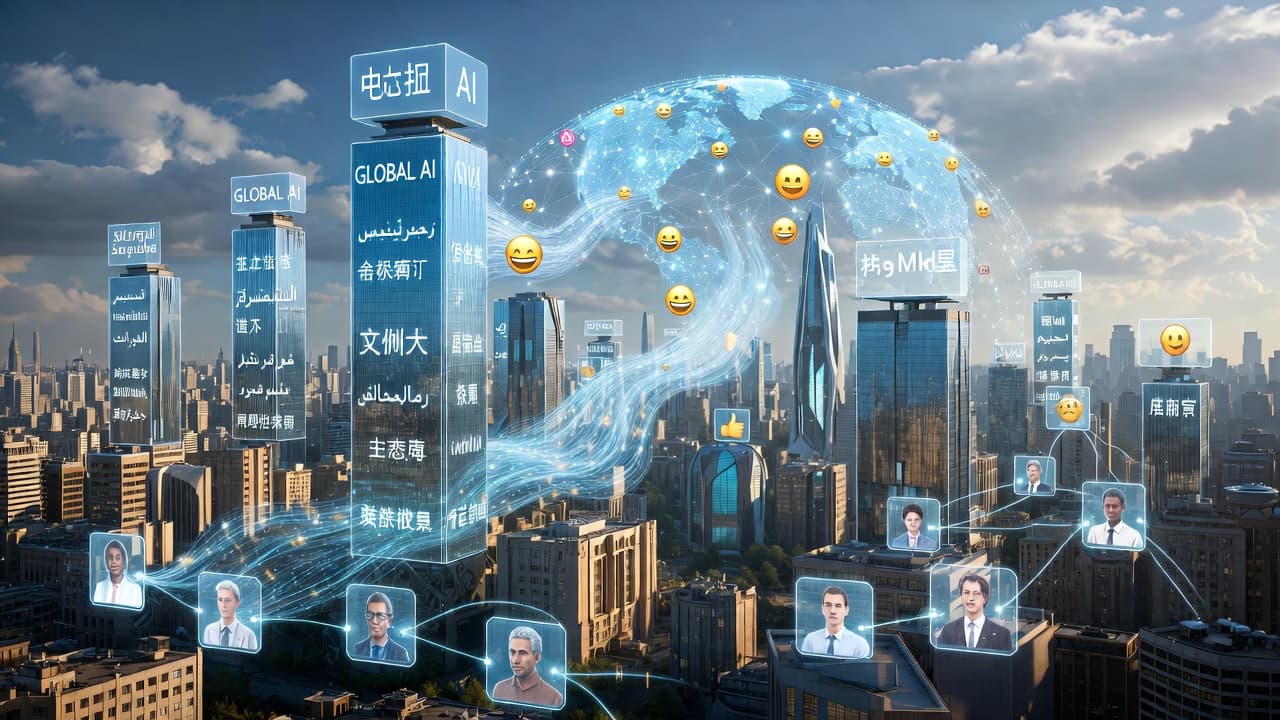
Artificial intelligence is already revolutionizing translation, with tools like neural machine translation (e.g., advanced versions of Google Translate or DeepL) achieving near-real-time accuracy across hundreds of languages. In the future, imagine ubiquitous AI earpieces or augmented reality glasses that provide instantaneous, context-aware translations during conversations, eliminating language barriers in global business, travel, and diplomacy. This could foster a "post-Babel" world where multilingualism becomes optional, allowing seamless collaboration on international projects like space exploration or climate initiatives.
However, this convenience might come at a cost. Over-reliance on AI could erode language learning skills, leading to a decline in cultural nuance—subtleties like idioms, humor, or emotional undertones might be flattened in automated renditions. Speculatively, AI could evolve into "creative translators" that not only convert words but adapt poetry, jokes, or literature to evoke equivalent feelings in the target culture.
Ethical concerns arise too: biased training data might perpetuate stereotypes, or governments could use AI to monitor and censor cross-border communications. By 2050, AI might even generate hybrid languages on the fly, blending elements from multiple tongues for specific contexts, like a "tech-speak" for programmers worldwide.
The Evolution of Digital Slang, Emojis, and Multimodal Communication
Digital communication has birthed a vibrant ecosystem of slang, abbreviations, and visual symbols, and this trend will likely intensify. Today's "LOL," "BRB," and memes could evolve into more sophisticated, AI-assisted expressions—imagine predictive text that suggests entire sentences based on emotional cues from facial recognition. Emojis, already a universal supplement to text, might become a full-fledged "emoticon language," with animated variants conveying complex narratives. For instance, a sequence of 🚀🌍💥 could shorthand a story about space travel and environmental disaster, interpreted differently across cultures but standardized via global apps.
In a speculative future, social media platforms could integrate haptic feedback or VR elements, turning language into a multisensory experience—words paired with vibrations for emphasis or scents for nostalgia. Digital slang might fragment into niche "netlects" for subcultures, like gamer jargon or eco-activist terms, but AI moderators could enforce inclusivity, auto-adapting slang for broader audiences.
Challenges include digital divides: those without access to advanced tech might be excluded from evolving conversations. By the mid-21st century, language could be predominantly multimodal, with text as just one layer alongside voice, gesture, and augmented visuals, blurring the line between human and machine expression.
The Potential for a Global Language
The dream of a single global language has persisted since Esperanto's invention in 1887, but globalization and technology make it more feasible today. English's current dominance might solidify into a "Global English" variant, simplified and enriched with loanwords from Mandarin, Spanish, and Arabic to reflect shifting power dynamics. Alternatively, a constructed language like Interlingua could gain traction, designed for ease and neutrality, or AI could engineer a new "UniLang" based on common phonetic and syntactic patterns from the world's top languages.
Imagine a world where education mandates this global tongue alongside native ones, facilitating instant understanding in international forums or emergency responses. Benefits include accelerated innovation—scientists collaborating without translation delays—and reduced misunderstandings in geopolitics. Yet, this could stifle diversity, as minority languages fade, eroding cultural heritage.
Speculatively, resistance movements might arise, promoting "language sovereignty" through blockchain-protected digital archives. By 2100, a global language might coexist with preserved local dialects, used situationally like formal vs. casual speech today.
Threats to Linguistic Diversity: Climate Change and Migration
Climate change and forced migration pose existential threats to linguistic diversity. Rising seas, droughts, and extreme weather could displace billions, scattering communities and disrupting intergenerational language transmission. For example, Pacific Island nations like Kiribati face submersion, potentially leading to the loss of i-Kiribati language as speakers assimilate into host countries. Similarly, Arctic indigenous groups like the Inuit might see their dialects diluted as youth migrate to urban centers for survival.
Mass migration waves—projected to reach 200 million climate refugees by 2050—could create "migrant lingos," hybrid forms blending origins with host languages, enriching urban dialects but accelerating extinction of isolated tongues. Governments might prioritize dominant languages in relief efforts, further marginalizing minorities. Imaginatively, "climate creoles" could emerge in refugee camps, fusing elements from diverse displaced groups, symbolizing resilience.
To counter this, international policies could mandate language preservation in migration pacts, using AI apps to teach endangered tongues to children. Without intervention, we might lose half of today's 7,000 languages by century's end, diminishing humanity's cognitive toolkit—each language offers unique perspectives on concepts like time, nature, or kinship.
Futuristic Concepts: Neural Interfaces and Beyond
Peering further ahead, neural interfaces like Neuralink could transcend traditional language entirely. Imagine "thought-speak," where brain-computer interfaces transmit ideas directly, bypassing words for instantaneous, empathy-driven communication—sharing not just concepts but emotions and memories. This could revolutionize education, therapy, and relationships, allowing polyglots of the mind to "speak" in pure intent.
Speculatively, language might evolve into "neuro-symbols," abstract mental constructs augmented by AI, enabling communication with non-humans like animals or extraterrestrials. Quantum computing could facilitate "parallel languages," where multiple meanings coexist until observed, mirroring quantum superposition.
Dystopian risks include privacy erosion—thoughts hacked or censored—or social divides between "enhanced" communicators and others. Utopian visions see a "hive mind" fostering global unity, but at the potential cost of individual expression. By 2200, language might be optional, a nostalgic art form amid telepathic norms.
Conclusion
The future of language is a tapestry of promise and peril, woven from technological marvels, environmental pressures, and human ingenuity. AI translation and digital evolutions could democratize communication, while a global language might unify us amid chaos. Yet, threats from climate change and migration underscore the need to safeguard diversity, lest we lose irreplaceable cultural treasures.
Futuristic neural interfaces hint at a paradigm shift, where language becomes more intuitive and interconnected than ever. Ultimately, the trajectory depends on our choices—prioritizing inclusivity and preservation could lead to a richer linguistic ecosystem, enhancing human potential in an increasingly interconnected world. As we speculate, one thing is clear: language will continue to evolve, mirroring our aspirations and challenges.
Master Languages for Tomorrow's World
As technology reshapes communication, learning multiple languages remains essential for understanding diverse perspectives and thriving in our interconnected future. Start your journey with AI-powered language learning through real-world news articles.