
Table of Contents
Introduction
The period from approximately 1500 to 1800 CE, encompassing the Renaissance and Enlightenment, was a time of profound linguistic transition. This era witnessed a revival of interest in classical languages like Greek and Latin, driven by humanism and the rediscovery of ancient texts, while simultaneously fostering the standardization and elevation of vernacular tongues through technological innovations such as the printing press.
Philosophical inquiries into the origins and nature of language flourished, with thinkers debating whether language was innate, divine, or a product of human society, influencing broader ideas about human cognition and civilization. Colonial expansions by European powers introduced linguistic imperialism, leading to the suppression of indigenous languages and the emergence of creoles and pidgins. This page examines these developments, drawing on historical linguistics and cultural history to illustrate how language evolved as a tool of intellectual, social, and imperial transformation, setting the stage for modern national languages.
Renaissance Revival of Classical Languages
The Renaissance, beginning in Italy around the 14th century and peaking in the 15th–16th centuries, ignited a fervent revival of classical languages. Humanists like Petrarch and Erasmus championed the study of ancient Greek and Latin, viewing them as models of eloquence and wisdom essential for intellectual renewal. This period saw the translation and dissemination of classical works, such as Plato's dialogues and Cicero's orations, which enriched European scholarship and literature.
Latin remained the lingua franca of academia, diplomacy, and the Church, but the Renaissance emphasized its "pure" classical form over medieval variants. Scholars produced grammars and dictionaries to standardize Latin, while Greek gained prominence after the fall of Constantinople in 1453, when Byzantine refugees brought manuscripts to the West. This revival influenced vernacular literatures; for instance, Italian humanists like Dante (though earlier) and later Boccaccio drew from classical models, while in England, figures like Thomas More wrote in Latin but inspired English adaptations.
The interest extended to Hebrew and other ancient tongues, fueled by biblical scholarship and the Protestant Reformation's call for direct access to scriptures. Martin Luther's translation of the Bible into German (1522–1534) exemplified how classical studies intersected with vernacular promotion, challenging Latin's ecclesiastical monopoly.
The Printing Press and Language Standardization
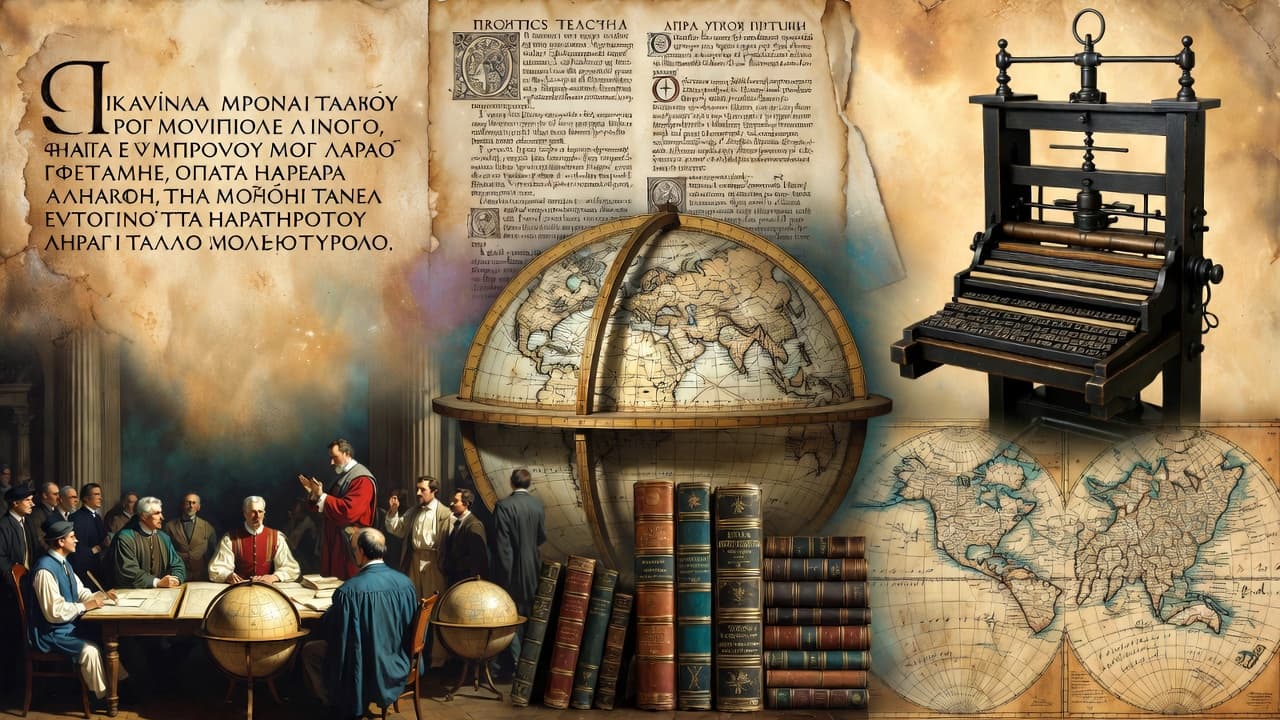
Johannes Gutenberg's invention of movable-type printing around 1450 revolutionized language dissemination, with its full impacts unfolding in the 16th–18th centuries. Printing enabled mass production of texts, accelerating literacy and standardizing national languages. By fixing spellings and grammars in printed books, it reduced dialectal variations; for example, William Caxton's press in England (1476) helped standardize English orthography.
In France, the Académie Française (founded 1635) codified French, producing the first official dictionary in 1694 to promote linguistic purity amid Enlightenment ideals. Similarly, in Spain, the Real Academia Española (1713) standardized Spanish, influenced by colonial needs. Printing also facilitated the spread of vernacular Bibles and literature, such as Shakespeare's works (printed from 1590s), which popularized Early Modern English.
This era saw a surge in grammars and dictionaries for vernaculars: Samuel Johnson's A Dictionary of the English Language (1755) epitomized Enlightenment efforts to systematize language, borrowing from Latin and Greek while establishing norms. The printing press thus democratized knowledge, shifting power from Latin elites to national vernaculars, though it also marginalized regional dialects.
Philosophical Debates on Language Origins
The Renaissance and Enlightenment sparked intense speculation on language's origins, moving from divine theories to naturalistic explanations. Early views, influenced by biblical accounts, posited language as a gift from God, but humanists began questioning this.
John Locke, in his Essay Concerning Human Understanding (1690), argued language was arbitrary and conventional, shaped by human agreement rather than innate ideas, influencing empiricism. Jean-Jacques Rousseau, in Essay on the Origin of Languages (published posthumously 1781), speculated language evolved from emotional cries to complex systems, linking it to social development and inequality.
Étienne Bonnot de Condillac (1714–1780) proposed language originated from gestures and natural signs, evolving into arbitrary symbols essential for abstract thought. Johann Gottfried Herder critiqued universalist views, emphasizing language's cultural specificity and role in national identity, foreshadowing romanticism. Projects for universal languages proliferated, like John Wilkins' An Essay Towards a Real Character (1668), aiming for a philosophical language to transcend barriers, though most failed. These debates reflected broader Enlightenment concerns with human progress, rationality, and society.
Colonial Expansion and Linguistic Impacts
European colonialism from the 15th century onward profoundly altered global linguistics. Portuguese, Spanish, French, Dutch, and English explorers imposed their languages on colonized regions, often suppressing indigenous ones.
In the Americas, Spanish colonizers enforced Castilian through missions and administration, leading to the decline of languages like Nahuatl and Quechua, though hybrids emerged. English in North America displaced Native American tongues, while African slaves contributed to creoles like Gullah.
In Asia and Africa, trade and conquest introduced European loanwords; for example, Portuguese influenced Swahili and Malay. The Enlightenment's "civilizing mission" justified linguistic imperialism, but contact also enriched European languages with terms like "chocolate" (from Nahuatl) and "kangaroo" (from Guugu Yimithirr). This era saw the beginnings of language extinction and pidgin formation, such as Tok Pisin in the Pacific, highlighting power dynamics in linguistic evolution.
Evolution of Major European Languages
English underwent the Great Vowel Shift (c. 1400–1700), altering pronunciation, while borrowing extensively from Latin, Greek, and French during the Renaissance, as seen in Shakespeare's vocabulary. French evolved into a diplomatic lingua franca, standardized under Louis XIV.
German, bolstered by Luther's Bible, diversified into dialects, while Italian, influenced by Tuscan, became a literary standard via Petrarch and Dante's legacies. Spanish and Portuguese expanded globally, incorporating indigenous elements.
Conclusion
From 1500 to 1800, language transitioned from classical dominance to vernacular ascendancy, propelled by Renaissance humanism, printing technology, philosophical inquiry, and colonial encounters. These changes not only standardized national languages but also globalized European tongues, often at the expense of indigenous diversity. By the Enlightenment's end, language was viewed as a human construct integral to society and thought, paving the way for 19th-century industrialization and further globalization.
Learn Modern Languages Today
The standardized languages of the Renaissance era continue to evolve. Start learning through real news articles and discover how these languages are used today.